
Confidence vs. Arrogance: The Difference That Changes Everything

They look alike from a distance. Up close, they couldn't be more different.
We've all been in a room with someone who commands attention without asking for it. There's a stillness to them. A groundedness. You trust them almost immediately, and you're not entirely sure why.
We've also been in a room with someone who demands attention — who fills every silence with their own voice, who subtly (or not so subtly) reminds you of their accomplishments, their status, their worth.
Both carry themselves with boldness. Both seem sure of themselves.
But only one of them actually is.
The Core Difference

Here's the line that cuts right to it:
Confidence knows who it is. Arrogance needs you to know who it is.
That single distinction explains almost everything. Confidence is an internal state. Arrogance is a performance — and like any performance, it only works if there's an audience.
Confidence is quiet certainty. It doesn't need to announce itself because it's not trying to convince anyone of anything, including itself.
Arrogance is loud insecurity dressed up as strength. Beneath the boldness is a question that never quite gets answered: Am I enough?
What Confidence Actually Looks Like
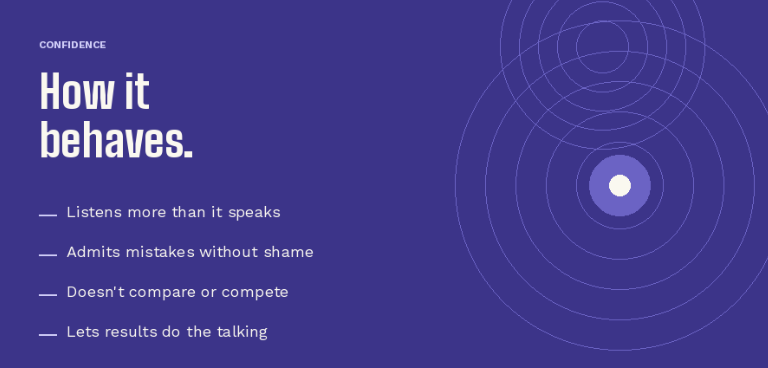
Confidence isn't silence, and it isn't passivity. Genuinely confident people speak up, take risks, and lead. But their behavior points inward — it's rooted in self-awareness, not self-promotion.
Confidence listens more than it speaks. A confident person doesn't need to dominate a conversation to feel valued in it. They can sit with silence. They can ask questions. They can be the least-talking person in the room and still be its most powerful presence.
Confidence admits mistakes without shame. This one surprises people. We tend to associate confidence with being right, but real confidence has nothing to do with being right all the time. It's knowing that being wrong doesn't make you less worthy. You can say "I got that wrong" without it threatening your entire sense of self.
Confidence doesn't compare or compete. Someone who is genuinely secure in who they are doesn't need to measure themselves against others. Your win doesn't threaten them. Their win doesn't need to diminish you. They're running their own race.
Confidence lets results do the talking. The work speaks. The reputation builds. The track record grows. And none of it requires a press release.
What Arrogance Actually Looks Like

Arrogance mimics confidence so well that we often mistake one for the other — especially in cultures that reward boldness and punish vulnerability. But the difference shows up in the details.
Arrogance talks over others. Not because it has something more important to say, but because being heard feels like winning. Every conversation becomes a subtle competition, and listening means losing ground.
Arrogance avoids accountability. When something goes wrong, there's always an external cause — the timing, the team, the circumstances. Accountability feels dangerous because it requires admitting imperfection, and imperfection threatens the entire image being maintained.
Arrogance needs to be "above" someone. This is one of the most revealing traits. Arrogance operates in hierarchy. It needs to look down to feel tall. It compares constantly — not to improve, but to position.
Arrogance seeks validation and dominance. Every interaction is an opportunity to be affirmed. To be seen as the smartest, the most experienced, the most valuable. And when that validation doesn't come, things get uncomfortable fast.
Same Outward Boldness. Very Different Inner Motives.
This is why we confuse them.
A confident person and an arrogant person might walk into the same room with the same energy. Both are willing to take up space. Both are willing to be heard.
But ask yourself: Why?
The confident person is simply present. They're not performing. They're not managing perception. They're just there, clear on who they are and what they bring.
The arrogant person is building a case. Every word, every interaction is a brick in a wall they're building around a fragile identity. They have to be seen a certain way because without that, they're not sure who they are.
One of these comes from abundance. The other from scarcity.
True Confidence Doesn't Need Applause

This might be the most important part.
Genuine confidence is indifferent to approval in the most freeing possible way. Not cold, not dismissive — but unattached. When someone doesn't like you, it doesn't unravel you. When someone doesn't recognize your value, you don't spiral. You know what you know. You trust what you've built. You keep going.
True confidence respects others — not out of obligation, but because secure people don't need to diminish anyone to feel worthy. When you know your own value, other people's success stops feeling like a threat.
True confidence stays humble while improving. This is the paradox that arrogance never understands: the most confident people are often the most coachable. They can hear criticism without collapsing. They can be a beginner without shame. Growth doesn't threaten them — it excites them.
True confidence knows its worth without proving it. This is the one that cuts the deepest. If you have to announce your power, you probably don't have it yet. Real authority is recognized, not declared. Real credibility is earned, not insisted upon.
The Practical Stakes
This isn't just a philosophical distinction. The difference between confidence and arrogance has real, tangible consequences for every area of your life.
Confidence builds trust. Arrogance burns bridges.
Think about the people in your life — at work, in relationships, in your community — who you genuinely trust and respect. Are they the loudest in the room? Or are they the ones who show up consistently, listen deeply, take responsibility, and make space for others?
And think about the people who've left damage in their wake. Who made collaboration harder. Who made others feel small. Who eventually found themselves alone, wondering why things didn't work out.
The pattern is almost always the same.
Which One Are You Building?
Here's the thing about confidence: it's not something you either have or don't have. It's something you build — slowly, through self-awareness, through experience, through failure, through honest reflection.
Arrogance, ironically, is often a shield. It shows up when we feel most uncertain. When we don't know our worth, we sometimes overcorrect — performing strength to cover up the doubt underneath.
The path out isn't self-criticism. It's self-honesty.
Start asking different questions. Not "How do I look to others?" but "Do I actually believe in what I'm doing?" Not "How do I show them I'm valuable?" but "Am I living in a way that reflects my values?"
The quiet work of building real confidence is unglamorous. But what it produces — genuine trust, lasting respect, unshakeable self-assurance — is worth more than any amount of applause.
You owe it to yourself to build the real thing.
